
.webp)
Most builders focus on winning work: sharpening the quote, chasing the callback. But the real competition happens earlier, weeks or months before, while the project is still a development application (DA) sitting in a council queue.
The busiest builders in 2026 aren't winning more pitches. They're finding the work first, using tools like Buildscout to track DA and planning data instead of waiting on referrals.
Winning work vs. finding work
There's a subtle but important difference between these two skills, and most building businesses only ever train the second one.
Winning work is what happens once a lead already exists: quoting well, following up fast, closing the deal. Finding work happens before that: spotting a project before it's common knowledge, so you're the first call, not the fifth quote in someone's inbox.
Builders who rely purely on referrals, directories, or paid leads are stuck in "winning" mode. They wait for the phone to ring, then compete on price with everyone else who got the same lead. Builders who track planning and development application data play a different game: they reach real, verified projects at the earliest possible point, often before the applicant has spoken to a single contractor.
What DA data actually tells a builder
A development application is a public record. Every time a homeowner or developer wants to build, renovate, or subdivide, they lodge a DA (or a complying development certificate, depending on the pathway) with their local council. That record includes the address, the scope of works, the applicant's details in many cases, and the stage the project is at.
On its own, that's one record. Multiply it across every council in Australia, and DA data becomes something much bigger: a live, filterable list of confirmed, real, intending builders and renovators, sorted by location, project type, and value, and updated continuously as new applications are lodged.
That makes it fundamentally different from a lead form filled out on a comparison site. A DA reflects real, funded intent, not idle browsing, because nobody lodges a $400,000 renovation application on a whim.
The scale is significant too. The Australian Bureau of Statistics recorded 17,687 seasonally adjusted dwelling approvals nationally in July 2026 alone, up 9.0% year-on-year despite a monthly dip, while non-residential building approvals were up 14.4% in the same month. That's a large, constantly refreshing pipeline of projects, and most of it never reaches a builder's inbox through referrals or directories at all.
Why timing beats almost everything else
Development approval timelines vary by state and pathway, but they all share one thing: a window between lodgement and determination, typically 20 to 90 days depending on the council and development type. That's the window that matters. It's when the applicant is doing exactly what a builder wants: researching costs, shortlisting trades, and getting quotes ready for when approval lands.
Two very different builders show up in that window. One waits until the DA is approved, listed, or referred, and arrives at the end of it, competing with whoever the homeowner already found. The other monitors DA activity as it's lodged, and arrives at the start of it, often as the only contractor who's reached out at all.
That head start, arriving first instead of last, is the real mechanism behind "finding work, not just winning it." It isn't a mindset shift. It's a timing advantage: fewer competing quotes per job, a better chance of being the only contractor in the room, and a pipeline that doesn't dry up the moment referrals go quiet.
From reactive quoting to a proactive pipeline
In practice, builders using planning and DA data as a lead source follow a simple loop:
Monitor: Track DA and planning activity in the councils and postcodes you actually work in, filtered by project type (renovations, extensions, new builds, commercial fit-outs) and value. Most builders do this with a tool like Buildscout rather than checking council portals by hand.
Qualify: Not every DA is a fit. Filter out the noise (subdivisions, signage applications, unrelated commercial works) so what's left matches your capacity and specialty.
Reach out early: Make first contact before the applicant has spoken to anyone else in the trade, rather than waiting to be found. Being early beats being loud.
Repeat, consistently: Treat it as a daily habit, not a one-off campaign: a steady 10 to 15 minutes a day, rather than a scramble whenever the job book looks thin.
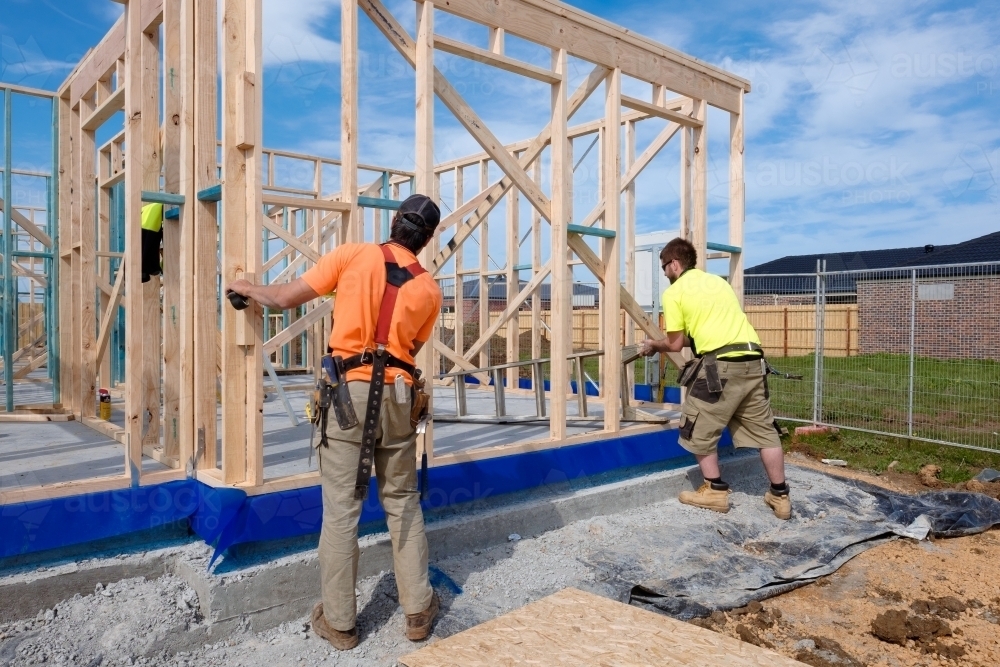
Picture a two-person renovation business in outer Melbourne. Historically, their pipeline lived and died by word of mouth: busy for a few months, then quiet, then busy again.
By monitoring DA lodgements in their area and reaching out while applications were still in assessment, they started talking to homeowners before those homeowners had collected a single quote. The work didn't get easier to win. It got easier to find in the first place, and doing that consistently is what fills a job book, not one lucky lead.
Why this matters more in a tighter market
Approval volumes don't move evenly. In the same ABS dwelling approvals data cited above, Victoria (+9.7%) and Tasmania (+15.2%) trended up in mid-2026, while New South Wales (-8.1%) and Queensland (-13.9%) pulled back. A builder relying on referrals has no early warning when their local market cools, because referrals lag well behind what's actually happening in the planning pipeline.
Builders tracking DA and planning data see that shift as it happens. If approvals drop in one council area, they can spot it in the data and shift their attention to councils, suburbs, or project types that are still active, instead of only noticing three months later that the phone has stopped ringing.
Data doesn't replace a builder's reputation, workmanship, or relationships. It replaces the guesswork about where to spend the time building those relationships nex
Getting started with DA data as a lead source
For builders who've only ever sourced work through referrals, directories, or paid leads, the shift to using planning and DA data doesn't require an overhaul. It requires a new habit and the right tool to support it.
- Define your ideal project profile (type, value range, location radius).
- Set up monitoring for DA and planning activity that matches it, rather than manually checking council portals.
- Build a simple, consistent outreach sequence for newly lodged applications.
- Track which councils and project types actually convert, and refine from there.
This is exactly the gap Buildscout was built to close. It gives Australian builders and contractors earlier visibility into planning and development application activity, so they can reach homeowners and developers while a project is still taking shape, not after it's already gone to quote.
Buildscout gives builders and contractors that earlier visibility as standard. See how it works, check pricing, or book a demo to see DA activity in your own service area.

.webp)
.webp)

.jpg)




.png)